This Easter holiday – Sunday, April 5 – coincides with the first Sunday of the month and that means free admission to all State museums! We have additional information on what to see and do in Florence and across Tuscany on these two dates as far as traditions and markets go, so this post will focus on the special openings and hours for the museums that are not covered in great detail on those two pages.
The fact that Easter falls on the first Sunday of the month makes it a great occasion for both citizens and visitors alike to freely access a large part of the museums of the State museums in Italy and here we address the ones that fall under the “Tuscan Regional” directorate, which are separate from the Uffizi and Accademia, who fall into different organizations.
Since Easter will be crowded, make note of the special openings on Easter Monday, where you can visit with a regular ticket, that guarantee an entire long weekend dedicated to culture and visits to great museum collections, monumental complexes, archaeological areas immersed in the landscape, and places of spirituality.
In Florence, on Easter Sunday and, extraordinarily, on Easter Monday, at the Museum of San Marco, you can admire the Hall of Beato Angelico, which reopened with a new layout featuring 33 panels by the famous friar-painter, making it the largest and most important collection in the world of the artist’s panel works. It also includes paintings never exhibited to the public before the recent exhibition dedicated to Angelico, such as the Franciscan Triptych of the Company of San Francesco in Santa Croce, reassembled in its entirety after the masterful restoration by the Opificio delle Pietre Dure, alongside the shaped cross returned to the master’s early production.
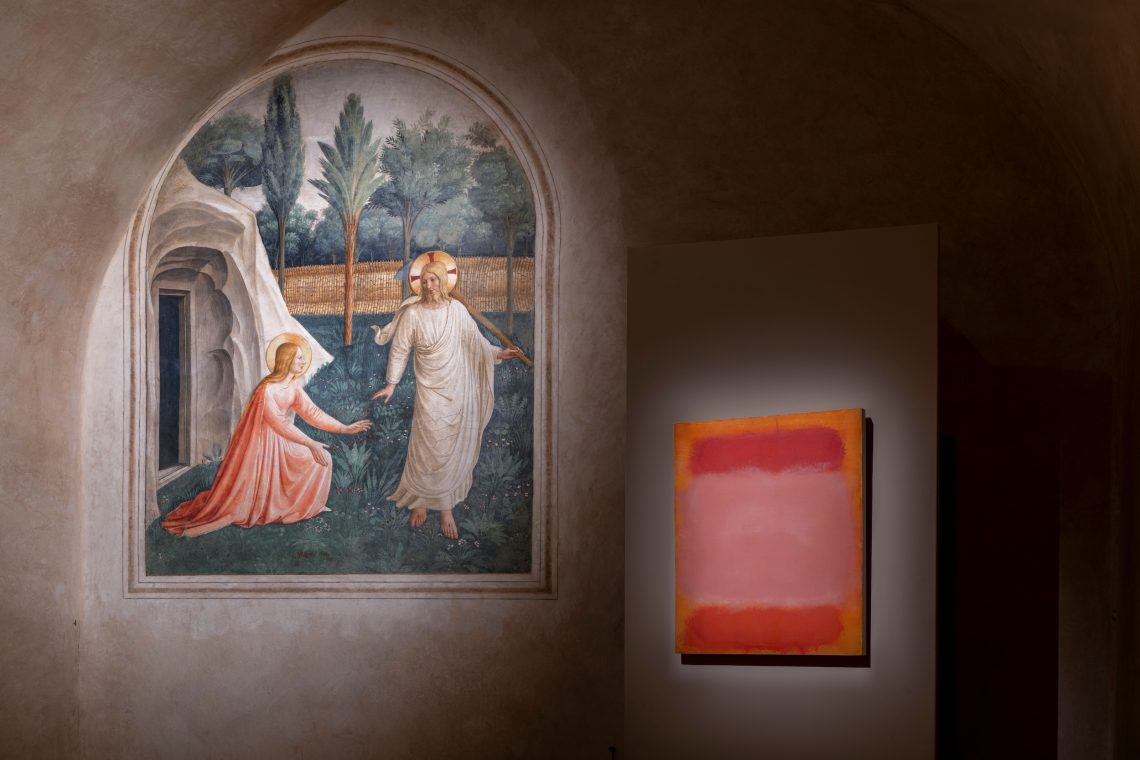
On the first floor of San Marco, a special section of the exhibition Rothko in Florence is set up: five works by Mark Rothko from important international collections, created with different techniques and belonging to different periods, are in direct dialogue with five of the frescoes in cells 1, 3, 4, 6, 7 that had inspired him so much. The choices were guided by affinities of color, material, and above all, spirit.
The path of the sacred finds its natural genesis in the Museum of San Marco, where the Easter narrative manifests in countless scenes within the meditative intimacy of the cells frescoed by Beato Angelico – for example in the Noli me tangere and in the Resurrection — in the panels of the Armadio degli Argenti, and in the monumental altarpieces, predellas, and pinnacles of his most famous works. This visual plot, charged with silence and meaning, is then completed and continues in the Florentine Cenacoli (Last Suppers), where the iconographies of the Last Supper, enriched by symbols recalling the Passion, offer the ideal culmination of this narrative through images. Specifically for the Easter festivities, this itinerary unites places of Dominican spirituality with the evocative refectories of Sant’Apollonia and San Salvi and the Chiostro dello Scalzo, offering an overall view of Renaissance painting that places the narrative of Angelico’s frescoes alongside the great tradition of Florentine Last Suppers.
Moving out of Florence, in Arezzo you will find several state museums open for the holidays. At the “Gaio Cilnio Mecenate” National Archaeological Museum, it will be possible to visit the exhibition “The Minerva of Arezzo. A story of a rediscovered community.” The famous bronze sculpture – found in the subsoil of Arezzo in 1541 and immediately donated to Duke Cosimo I de’ Medici who placed it in his private study in Florence, has been exhibited in the National Archaeological Museum of Florence since 1871 – but is currently located in one of the most evocative rooms of the Roman section of the Arezzo Museum, where it is presented through an updated and immersive narrative that traces its discovery, its Florentine collecting fortune, and its complex conservation history.
At the Museum of Casa Vasari, the Chamber of Abraham, Vasari’s wedding chamber, is again open to visitors, being one of the most significant rooms of the house-museum. The roof garden has also reopened, an evocative outdoor space that represents a distinctive element of the Vasarian residence: conceived as a place of quiet and contemplation, it integrates architecture and nature according to the Renaissance sensitivity for harmony between the built environment and the landscape.
The Museum of Casa Vasari and the Basilica of San Francesco in Arezzo also offer the public audio/video guides in Italian Sign Language “Signs of Art –”, created by the Tuscany Regional Directorate of National Museums in collaboration with the National Body for the Protection and Assistance of the Deaf- ENS Provincial Section of Arezzo, which tell the stories of authentic masterpieces of art history, such as Piero della Francesca’s Legend of the True Cross.
The National Museum of Medieval and Modern Art: through a chronological path ranging from the early Middle Ages to the nineteenth century, organized across twenty rooms, it preserves and displays one of the most representative collections in Tuscany.
In the surrounding area, the Museum of Popular Arts and Traditions of the Upper Tiber Valley – Palazzo Taglieschi allows an in-depth look at local traditions through its extraordinary collection of Della Robbia glazed terracotta and wooden sculptures, among which the famous Madonna and Child by Jacopo della Quercia stands out.
In the Archaeological Area of Sodo at the foot of the hill below Cortona, you can visit two funeral monuments that celebrated the prestige of aristocratic families from the archaic age and one of the few examples of an Etruscan tomb that still preserves a monumental altar decorated with sculptures and ornamental motifs dating back to the beginning of the 6th century BC.
The Abbey of Soffena, a small jewel of the Arezzo Valdarno in Castelfranco Piandiscò, will be open only on Easter Monday to show the public its most precious treasure: the splendid late Gothic and Renaissance frescoes, among which the Annunciation by Giovanni di Ser Giovanni, known as lo Scheggia, the younger brother of Masaccio, stands out.
Moving westward, in the province of Livorno, citizens and visitors to the Island of Elba will be able to visit the National Museum of Napoleonic Residences – Villa S. Martino in Portoferraio. The evocative summer residence of Napoleon Bonaparte, immersed in greenery, is a place rich in history and charm.
The Archaeological Museum of Castiglioncello, open only on Easter, in the large Poggetto pine forest near Porticciolo Bay, exhibits a selection of materials from the promontory’s necropolis.
In Pistoia, both the Fortezza di Santa Barbara, the former Church of Tau, and the Oratory of San Desiderio are open both days, as always for free.
Open on Easter and Easter Monday is the Archaeological Area of Comeana (PO) – Montefortini Mound. The structure is a 12-meter high artificial mound housing two burial chambers; the main one is a monumental tholos (circular) tomb from 640-630 BC.
In Chiusi (SI), the National Etruscan Museum will be open both days. Furthermore, the exhibition «A young man of great promise…. Ranuccio Bianchi Bandinelli 1922-1929» has just been extended until June 28, 2026.
Openings of more museums in Tuscany:
On Easter and Easter Monday
- At the National Archaeological Museum of Florence, last days to visit the exhibition Icons of Power and Beauty.
- Medici Villas of Petraia, Poggio a Caiano, and Cerreto Guidi, for the Garden of the Medici Villa of Castello and Villa il Ventaglio Park.
- Pisa and province: Museum of Ancient Ships, Museum of San Matteo, and the Charterhouse of Calci. Open only Sunday, April 5, is the National Museum of Palazzo Reale.
- National Museums of Lucca: Palazzo Mansi National Museum and Villa Guinigi National Museum, where the exhibition “The King’s Painter. Luigi Norfini in Risorgimento Italy” is ongoing.
- Archaeological Parks of Maremma: Cosa, Roselle, and Vetulonia.
Please note: if there are yellow/orange/red weather alerts, the parks, gardens, and outdoor areas may be closed to the public.
Opening days and hours (*** = Free Admission)
Here’s a summary of the hours for many of the museums, and more, mentioned above for your convenience:
FLORENCE
- MAF National Archaeological Museum of Florence
- Easter: 8:30-14:00 (last entry 13:15)
- Easter Monday: 8:30-14:00 (last entry 13:15)
- Museum of San Marco
- Easter: 8:30-13:50 (last entry 12:45)
- Easter Monday: 8:30-13:50 (last entry 12:45) extraordinary opening
- Cenacolo di Sant’Apollonia
- Easter: 8.30 – 14 (last entry 13.50)
- Easter Monday: 8.30 – 14 (last entry 13.50)
- Cenacolo di Andrea del Sarto
- Easter: 8.30 – 14 (last entry 13.20)
- Easter Monday: 8.30 – 14 (last entry 13.20) extraordinary opening
- Chiostro dello Scalzo
- Easter: 8.30 – 14 (last entry 13.20)
- Easter Monday: 8.30 – 14 (last entry 13.20) extraordinary opening
- Villa il Ventaglio Park ***
- Easter: 8:15 – 18:30
- Easter Monday: 8:15 – 18:30
- Garden of the Medici Villa of Castello
- Easter: 8:30-18:30 (last entry at 18:00)
- Easter Monday: 8:30-18:30 (last entry at 18:00) extraordinary opening
- Medici Villa della Petraia
- Easter and Easter Monday: Garden 8.30 – 18.30. Villa entry at specific times (9.30, 10.30, 11.30, 12.30, 14.00, 15.00, 16.00, 17.00).
- Medici Villa of Cerreto Guidi
- Easter & Easter Monday: 8:30 – 17:30 (last entry 17:00) extraordinary opening
AREZZO
- Basilica of San Francesco
- Easter: 13:00-18:00; Easter Monday: 9:00-19:00
- “Gaio Cilnio Mecenate” National Archaeological Museum
- Easter: 9:00-19:30; Easter Monday: 9:00-14:00
- Museum of Casa Vasari
- Easter & Easter Monday: 8:30-13:30 (last entry 12:30)
- Abbey of San Salvatore a Soffena ***
- Easter: Closed; Easter Monday: 14:15 – 18:45
GROSSETO
- Archaeological area of Roselle
- Easter & Easter Monday: 9:45 – 18:45 (last entry 18:00)
LIVORNO
- National Archaeological Museum of Castiglioncello ***
- Easter: 10:00-13:00; Easter Monday: Closed
LUCCA
- National Museum of Villa Guinigi & National Museum of Palazzo Mansi
- Easter & Easter Monday: 9:00-19:30 (last entry 18:00)
PISA
- Museum of Ancient Ships of Pisa
- Easter & Easter Monday: 14:00-19:30
PRATO
- Medici Villa of Poggio a Caiano
- Park: 8:15-17:00. Villa: Reservation required (every hour from 8:30-15:30).
SIENA
- National Etruscan Museum of Chiusi
- Easter & Easter Monday: 8:30 – 14:00 (last entry 13:20)

About Lourdes Flores
An American living in Florence for over 10 years, Lourdes continues to explore and discover new places in Tuscany with the eyes of a tourist but with the experience of living in Italy. She shares her experiences on this blog and website, particularly offering lots of travel planning help on the Forum!