




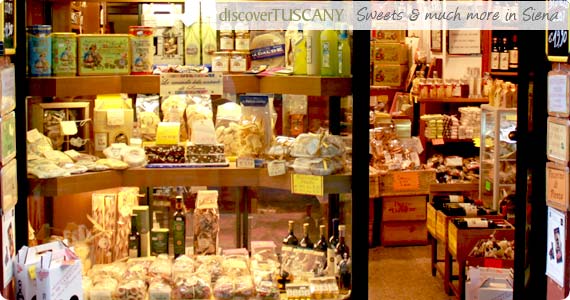
"Sweet Siena": a Journey through Traditional Specialites
During the centuries-old competition between the city of Florence and Siena, there is a challenge that even the most temerarious Florentine has never issued!
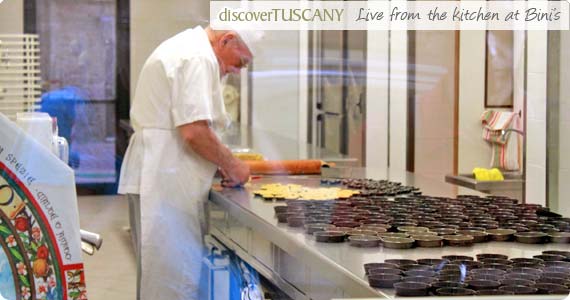
The best Confectioneries
Would you like to purchase or taste some excellent ricciarelli or cavallucci, panforte and other specialities of Siena tradition? Then make a note of those addresses: Nannini: it has many dealers, one is in the very centre of the city: Banchi di Sopra Street, 24. Website: www.grupponannini.itPasticceria Nocino: Aretina Street, 13 (close to Porta Pispini) Pasticceria Le Campane: Caduti di Vicobello Street, 37 (close to Porta Camollia) Pasticceria Bini: Stalloreggi Street, 91The non-starter challenge concerns the delicacies, especially the traditional sweets! A hypothetic arbiter would suspend the competition for “evident inferiority” and would assign the win to the Senese 3 to 0. The sweet pearls of which Siena is justly proud are almost three, as the Dumas musketeers, and they are enthusiastically appreciated by all the gluttons, especially at Christmas! Their name are: cavallucci, ricciarelli and panforte. The history of their origin has lost in time, they are the results ofa series of attempts and private recipes refined in the course of time with the addition of new ingredients. It has to be considered a sort of darwinian evolution of the sweet specie, which took place within monasteries and ancient grocery stores!< Keep using terms of the sport world, this could be considered the order of arrival on podium of the 3 traditional specialities:
Bronze Medal for Cavallucci
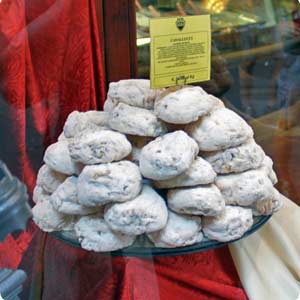
I Cavallucci, Little Horses.
Those are biscuits made by flour, honey and sugar, in the shape of a half apricot. They have good consistence and it is said the name comes from an old tradition which dates back to the 16th century. At that time, the biscuits were eaten in old coach stage innsby people who traveled with horses. They were perfect to take with since they can be preserved for a long time. The current recipe, compared with the ones of the past time, offers a greater softness. This final and refined product is the result of a combination of many variants, which contributed to create the excellent biscuit.
Today, important ingredients of the cavallucci are the candied orange and the anaci which contribute to make it very palatable. They perfectly match with an authentic Tuscan Vinsanto, not too sweet, but also with a good young Chianti wine.
Medaglia d’argento ai Ricciarelli
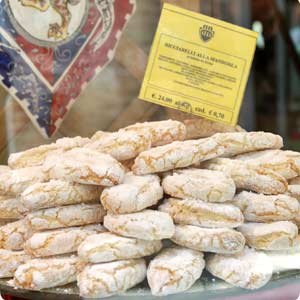
RicciarelliThey are very refined biscuits. They could assure eternal fame to its creator if only was known. As for the most part of traditional sweets, we didn’t know the origin.Not too thick, tender, crisp and delicate in the shape of a lozenge, they are marzipan-based.We read that the Marzipan cake of Siena was very appreciated even by the noble families of the 16th century, beyond Tuscan borders.The legend says that the lozenge of the early biscuits had curled tips, as the one of the oriental booties. They took the name from this.Some of their ingredients are the key of the success and delicious flavour: orange peel, candied citron which incredibly match with the taste of the almond. Those ingredients are delicately ground together, only the most sophisticated palates are able to distinguish the taste of cinnamon among those.
Ricciarelli are sold both unpacked and packed in beautiful boxes which can be a perfect present throughout the year. If you go to Siena and you know someone there, ask where you should buy the ricciarelli; apart from the most prestigious cake shops, such as Nannin in the very centre of the city at 24 of Banchi di Sopra Street,(and other shops around Siena) you could be lucky and get some indications of other delicious workshops.
Among the numerous cake shops sit in Siena, we recommend the pasticceria Nocini at 13 of Aretina Street, close to Porta Pispini and the Pasticceria Le Campane, at 37 of Caduti di Vicobello Street in the zone of Porta Camollia.Ricciarelli perfectly go with a medium-dry sparkling wine or with a almond based liqueur. Is also suggested it to savour with a good Elba
Medaglia d’oro il Panforte
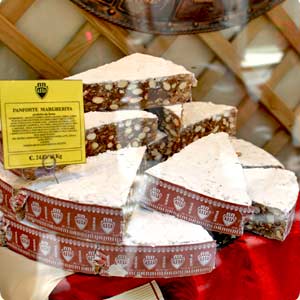
Gold Medal for Panforte At the beginning Panforte was very poor in ingredients in the course of time it has became very rich: of course in spices, taste and smell.
Its name comes from its medieval progenitors. “Sa di forte” or “Full-flavored” it’s a Tuscan way of saying of a quite sour dish or drink.
Among its progenitors we find the Honey traditional bread: it was a bread made by sweet water contained within honey jars and pieces of fruits both natural or stewed in the oven.
This bread didn’t preserve for a long time and its taste quickly became “pungent”, “Forte” in italian. From the 13th century the holy wars borough new spices to Europe; they were used for the first time by drysalters. To Pepper, cloves and cinnamon were attributed to many qualities, among these also medical virtues, which were nonexistent. They were instead really able to give new flavors and to prolong the preservation of food.
But the spices were also expensive and rare. Considered precious goods, appreciated as much as gold, even more, they were offered to Churches or Monasteries by the merchants who came back from risky journeys through the far East. This is the reason why the first grocery stores developed within Abbeys and were considered like pharmacies. Spices quickly started to be used to cook: one thought food could heal the body.
Today the bread isn’t “forte” anymore, it gains new flavor and a longer preservation becoming Panpepato. His Majesty the Panforte is the result of the combination of panpepato with other ingredients: which creates a wise symphony of tastes; only the name remembers us its humble orings. There are many legends which concern the origin of Panpepato. One of this also involves the devil. It is said that in a Convey the devil, turned into a mouse, entered into a locked blanket chest full of honey, flour, pepper, nuts, almonds, cinnamon, and other precious spices.
Of course the mouse started to nibble and scatter around the chest these God's goods - not properly the appropriate expression since we are talking about the devil! :) When the nun noticed the disaster, turned pale because was she afraid of being scolded by the mother superior and she didn’t know what to do. Lost in confusion, she heard a voice who suggested her to put everything on fire and slowly mix the ingredients.The voice was the one of the devil, who took the form of a black cat and talked to the nun with a persuasive voice. The poor woman, used to obedy, began to do what he said till she realized that the cat has never talked before. When she guessed it was actually the devil she threw at the cat the entire boiling pot. The animal activists didn’t exist yet and the cat went away whimpering. I
Another version recounts that the cat turned into the devil and vanished in a cloud of sulphur.
Have you ever heard about a devil scared by fire?
Anyway the trembling nun, between a sign of the cross and another, called the Mother Superior for help and she tasted the remnant in the pot. She was so enthusiast for it that ordered the sister to do the recipe again, it was so good that it would have made the convey become famous . The poor nun has been doing the panforte for all her life. This is the legend!
Today is Siena you can find many panforte recipes, the sweet is sold within beautiful and coloured boxes: you can choose among different variants, from the traditional one up to the chocolate panforte! Each recipe is jealously kept and passed down by the main industrial confectioneries of the town, such as Sapori, Neri and so on.. While strolling around the city pay attention to the pharmacies, you will notice that some of them have the same name of these main confectioneries. It testifies the origin of panforte which grounds its roots in the ancient world of spices. You can curiously find a “panforte style” also in the furnishings. So some trade magazines call the furnishing of the Farmacia Il Campo, in Piazza del Campo.
At the end, the wood medal: Pan co’santi. A real brown bread, made by nuts, raisins, a bit of pepper and so on... to eat divided into slices. Traditionally consumed in october and november, it perfectly goes with vinsanto or a young wine just coming out from the cellar. Resist the temptation to change the classification with an ex aequo.

About Umberto Romeo
Born and raised in Florence thanks to his maternal grandparents enjoys a good knowledge also of Siena and its special way of life. Unusual fan of both those two very magnificent even long fighting towns has special interest in their ancient and modern relationship. Former senior vice president manager and head of the international dept of a bank, when retired he discovered new interest in country life and researches about the tradition of the amazing territorio where his roots are. His works appeared on book and magazine.
You might also like:
Tuscany Typical Products | Siena
Did you find this article interesting? Share it!
Questions? The right place to ask is our Forum!
(questions posted on Comments below will no longer receive replies: so post on our Forum!)
blog comments powered by Disqus View all Articles